
Questions to Ask When Considering Diesel Mechanic Schools in NY
When you’re looking for a diesel mechanic school near you in New York, it’s helpful to start by asking questions about things like financial aid, term length, curriculum highlights, job support, and accreditation. NYADI The College of Transportation Technology provides a Truck and Diesel Service Technology program and an Automotive and Diesel Technology program in Jamaica, NY. Here, we discuss some essential questions to ask while exploring your diesel technician training options.
Key Takeaways
- Choosing the right diesel mechanic school in NY starts with understanding accreditation, certifications, and hands‑on diesel technician training.
- Comparing program length, schedules, tuition, and financial aid helps you find a diesel technician pathway that fits your goals.
- NYADI offers modern labs, small classes, and career support to help students succeed in automotive technology and meet the demand for diesel technicians.
Is the Diesel Mechanic School Accredited?
Accreditation signals that a school meets recognized academic and training standards. It’s important to confirm that the school you choose is accredited, as it reassures employers that your coursework, shop procedures, and safety practices align with their expectations on the job.
At NYADI, our programs are accredited by Accrediting Commission of Career Schools and Colleges (ACCSC), so you can trust in the quality of our education.
What Is the Program Curriculum Like?
It’s essential to evaluate each program’s curriculum and what it covers to understand what you’ll be learning. You want to choose a program that emphasizes hands-on vehicle exposure, current diagnostic tools, and real‑shop documentation practices, helping you meet the expectations of employers across the field.
At NYADI, our diesel curriculum builds key fundamentals, reinforces them in labs, and ties every skill to shop procedures. Courses are sequenced to teach core systems first, then diagnosis and repair on live vehicles. This ensures training mirrors day-one job tasks.
Some courses include:
- Performance Fundamentals, where students learn four‑stroke engine operation, component identification, and pinpoint diagnostic testing
- Heavy Duty Steering & Suspension, which builds understanding of tires, wheel bearings, and steering and suspension systems through hands‑on service and safety procedures
- Manual Drive Trains & Axles, which strengthens knowledge of clutches, manual transmissions, drivelines, and final drive systems
Is the Curriculum Aligned with Industry Certifications?
In the automotive industry, certifications are often pursued to demonstrate a technician’s skills and expertise. Certifications from the National Institute for Automotive Service Excellence (ASE), in topics such as diesel engines, electrical systems, and brakes, are widely recognized signals of competency. When you’re comparing schools, ask how the curriculum maps to ASE certification exams and request examples of lab exercises, tools, and live‑vehicle work.
At NYADI, our coursework and hands‑on labs are designed to reinforce ASE task lists, making it easier to translate classroom learning into certification readiness and job‑ready skills. We also offer a student guide to ASE certification for additional guidance.
Does the Program Provide Hands-On Training?
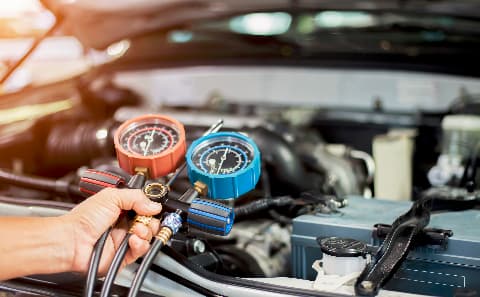
Hands-on training is imperative in automotive training, so you feel confident working on vehicles when you complete your program. Ask about the hands-on training you’ll do, as well as the use of training equipment and labs.
At NYADI, we build hands-on training into every program. Students will work with scan tools, oscilloscopes, alignment and brake equipment, and live vehicles to practice torque application, repair‑order notes, and safety procedures. This mirrors industry expectations and helps them perform accurate diagnostics, from reading data and confirming faults to validating repairs.
What Is the Typical Duration of Diesel Technician Programs?
Diesel training programs can vary in length based on the credential you pursue, so it’s imperative to understand how much time you’ll need to commit. Training may span several months for certificate programs or extend over a longer period for degree paths. At NYADI, our certificate programs take 12 to 18 months to complete, and our degree programs take 16 to 25 months, depending on part-time or full-time course load.
Is There Flexible Scheduling or Other Student Support?
Flexibility for part‑time or working students is often important, as many students balance work, family, or other responsibilities while training. Other support services, such as advising or tutoring, are also key to ask about, since they can help students throughout their program.
At NYADI, we support these needs with day and evening options, structured lab schedules, and support services that help keep students on track. We pair small class sizes with one-on-one tutoring and lab-based coaching to help students strengthen core skills. Students also have access to tutoring, academic assistance, and career services to connect students to networking opportunities. We also offer the Ability-to-Benefit (ATB) program, which allows students to earn their high school diploma and attend automotive technology career training.
Take the Next Step Toward Your Diesel Technician Career at NYADI
If you’re ready to start training for a diesel technician career, apply to NYADI today. Our diesel programs are accredited, offer in-depth, hands-on training from experienced instructors, and provide students with access to several support services. To learn more about our diesel mechanic school near you in NY, contact us today.
FAQs About Diesel Mechanic Schools in NY
Does NYADI offer partnerships with automotive brands?
Yes, we have partnerships with major brands, such as Audi, Ford, and Mercedes-Benz, to help you connect with future employers.
What financial aid options are available at NYADI?
At NYADI, we offer financial aid opportunities for students who qualify, including loans, grants, and scholarships.